
%20copy.png)
Why Investing in Technology for Adult Social Care and Health Is Practically Simple – but Politically Complicated
- Harry MacLean

- Dec 18, 2025
- 4 min read
Updated: Apr 15
Few people working in adult social care or health would argue with the principle that we need to invest more wisely. Demand is rising, workforce pressures are persistent, and outcomes for citizens are too often compromised by delays, duplication and fragmentation. Most of us also agree that technology, when it genuinely works, should be part of the solution.
On the surface, this feels straightforward. Invest in proven technology, improve productivity, share information better, and support people earlier and closer to home. Yet anyone who has tried to make this happen at scale knows that it is anything but simple. The real barriers are not technical. They are political and financial, and they sit in the tensions between central government, devolved parliaments and local authorities.
A system pulling in different directions
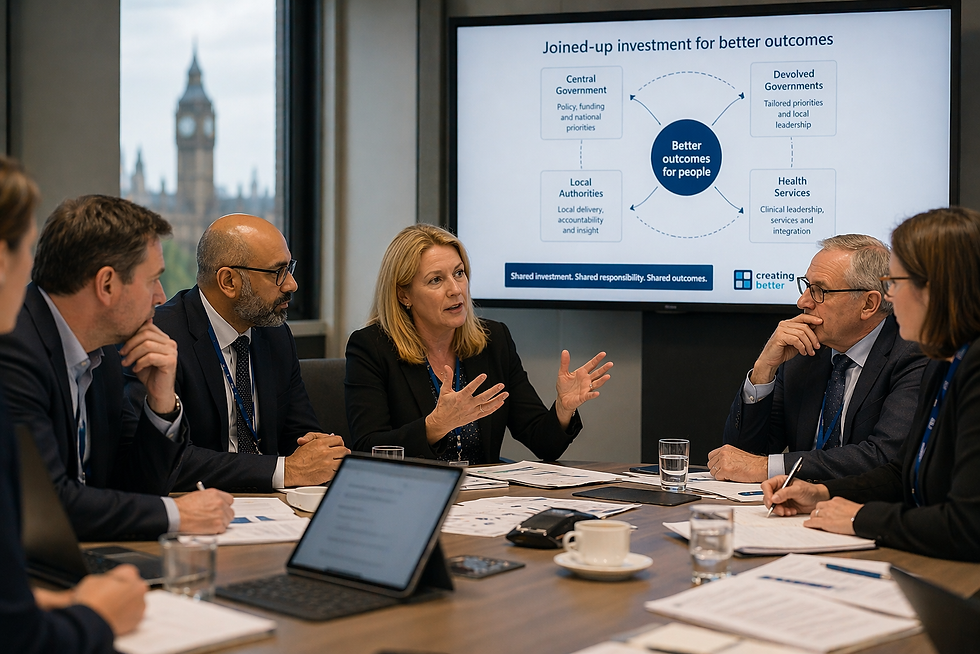
Adult social care and health exist in a uniquely complex governance space. Central government sets national policy, controls most taxation and often drives reform through targeted, short-term funding. Devolved governments shape priorities in line with their political mandates. Local authorities, meanwhile, are responsible for delivering adult social care on the ground, managing real people, real risks and real budgets.
These layers are not always aligned. Central government understandably focuses on national outcomes, fiscal control and visibility. Devolved administrations want autonomy to design systems that reflect local needs and political commitments. Local authorities are left balancing statutory duties with shrinking resources, rising demand and limited flexibility over income.
When it comes to funding, the misalignment becomes acute. Health funding is often protected, long-term and nationally prioritised. Adult social care funding is frequently time-limited, competitive and constrained. Responsibility and control rarely sit in the same place.
When political control is split, conflict becomes structural
These challenges are intensified when national government is controlled by one political party, while devolved governments and many local authorities are controlled by another. In this context, adult social care and health funding can become a proxy battleground for wider political disagreement.
National government may be reluctant to devolve long-term funding flexibility, concerned about losing control of spending priorities or political credit. Devolved governments and councils may view national initiatives with scepticism, seeing them as short-term, politically driven, or misaligned with local need.
Trust erodes quickly in this environment. Funding announcements are interpreted not just as policy decisions, but as political signals. Conditions attached to funding can feel like attempts to exert control rather than support delivery. At the same time, local caution or slow adoption is often framed as obstruction, rather than a rational response to financial risk and uncertainty.
Central control versus local accountability
This political split creates a fundamental tension around accountability. Central government controls most of the funding and sets the broad direction, but local authorities remain legally accountable for adult social care outcomes. When things go wrong, it is councils that face public scrutiny, judicial challenge and reputational damage.
From a local authority perspective, this can feel like responsibility without power. Decisions about funding levels, workforce pressures and national priorities are made elsewhere, yet councils must manage the consequences. Where political control differs, there is little incentive for national government to fully acknowledge these constraints, particularly when local government is led by an opposing party.
Who pays, who benefits, and who takes the risk?
Technology investment exposes these tensions very quickly. A digital solution might reduce hospital admissions, speed up discharge or prevent deterioration. The financial benefit, however, may accrue to the NHS or central government, while the cost and delivery risk sit with local authorities.
This creates a rational dilemma. Why invest scarce capital and revenue in technology when the savings do not return to the same budget? Why take on implementation risk when funding is short-term and success may simply lead to future grant reductions?
Short-term and ringfenced funding becomes more common in these circumstances. While often presented as targeted reform investment, it also allows national government to retain control and visibility. For technology, this is particularly damaging. Digital transformation requires multi-year commitment, cultural change and sustained revenue funding. Annual or competitive funding rounds encourage caution, not ambition.
Devolution adds another layer. Devolved governments may deliberately differentiate policy to reflect political values and demonstrate autonomy. This can drive innovation, but it can also make alignment, scaling and shared learning harder across systems.
Why “technology that works” is not enough
There is a persistent assumption that if technology demonstrably works, adoption should naturally follow. In reality, evidence is only one factor. Funding certainty, political accountability, procurement rules, workforce capacity and data governance all shape decisions.
Pilots may prove value but offer no route to sustainability. National programmes may mandate platforms without accommodating local context. Local innovation may succeed but struggle to scale beyond a single authority. None of this reflects a lack of goodwill. It reflects a system where incentives are misaligned.
The human cost of political misalignment
What is often lost in these debates is the impact on people who rely on care and support. Delayed decisions, fragmented systems and stalled investment affect hospital discharge, access to care, continuity of support and the ability of professionals to do their jobs well.
Political disagreement is a legitimate part of democracy. But when it hardens into institutional stalemate, adult social care and health are particularly exposed because they sit at the intersection of national funding power and local delivery reality.
Moving beyond political trench lines
If we are serious about investing in technology that improves adult social care and health, we need to address these underlying tensions. That means more joined-up funding models that share costs and benefits across health and care. It means longer-term financial commitments that allow local authorities to invest with confidence. It also means involving local government earlier in national policy design, rather than treating implementation as an afterthought.
Most importantly, it requires political maturity. National government needs to trust devolved and local systems with greater stability, even when they are politically opposed. Devolved governments and councils need to engage constructively with national priorities, even when they did not design them.
Technology can help. But until responsibility, funding and reward are better aligned, investing in technology that works will continue to feel obvious in theory and painfully complicated in practice.
Does anyone out there know how to get all the big players in the same room at the same time so we can jump forward as a country? The public deserves it.
Comments